Beyond the Headlines: What a Serious Injury Taught Ed Hudson About Rehabilitation and the Long Term
Recent national media coverage, including an article in The Times, told the story of Ed Hudson, trainee solicitor at Barratts Solicitors, walking down the aisle at his wedding, five years after a cycling accident left him with a high-level spinal cord injury. It was a moment that resonated widely, capturing resilience, adaptation and the significance of a milestone once thought impossible.
That moment, however, represents only a single chapter in a much longer and more complex journey. Behind the headlines lie years of medical treatment, rehabilitation, adjustment and planning. Over time, Ed gradually reshaped what life could look like after catastrophic injury.
This article looks beyond the public story to reflect on what Ed learned along the way – about spinal injury, the realities of rehabilitation, and the importance of long-term thinking at a time when the future can feel impossibly uncertain. Drawing on his perspective as a former doctor, a person living with a spinal cord injury, and now a trainee solicitor working in serious injury law, Ed offers insight shaped not by theory, but by lived experience over time.
This article may be helpful if you:
- Have recently been seriously injured
→ What happens after a high-level spinal cord injury - Are supporting someone through rehabilitation
→ Why early rehabilitation can feel slow and uncertain - Are feeling frustrated with slow or unclear progress
→ How specialist rehabilitation can change what is possible - Want to understand long-term planning after injury
→ Why long-term planning matters in catastrophic injury cases - Are trying to make sense of life after serious injury
→ Life after injury is about adaptation, not “overcoming” - Are at the very beginning and feeling overwhelmed
→ If you are newly injured: what the early months can feel like
What Happens After a High-Level Spinal Cord Injury: Understanding Versus Living It
In February 2018, Ed was cycling to work at the Queen’s Medical Centre in Nottingham, where he was working as a Foundation Year 1 doctor in general surgery, when he was hit by a car and thrown from his bike. He sustained a high-level spinal cord injury at C4/C5, resulting in tetraplegia.
He underwent surgery and spent a prolonged period in intensive and high dependency care before being transferred to a specialist spinal injuries unit.
As a doctor, Ed understood immediately what a high cervical spinal injury could mean. He was aware of the likely implications for movement, sensation and breathing, and of the seriousness of what had happened. That clinical knowledge, however, did not prepare him for the lived reality of the months that followed.
In the early stages after injury, life became confined to a single space and a tightly controlled routine. Everyday actions required assistance, and decisions about movement, comfort and timing were largely out of his hands.
The contrast between understanding an injury in theory and experiencing the loss of independence that followed was stark. What Ed had known intellectually as a clinician quickly became a personal experience of dependency, restriction and uncertainty that would shape the years ahead.
Why Early Rehabilitation Can Feel Slow and Uncertain After Serious Injury
For many people, the early phase of rehabilitation is one of the most frustrating parts of recovery.
Ed’s early recovery was marked by a prolonged stay in hospital, where the focus was necessarily on medical stability rather than rehabilitation in its broader sense. Months were spent in a ward environment that offered limited privacy and little opportunity for autonomy.
While essential care was provided, the setting placed clear constraints on how much progress could realistically be made, particularly for someone with a high-level spinal injury. In an under-resourced system, the pace of rehabilitation felt slow and uncertain.
Daily routines were dictated by availability rather than individual need, and opportunities to practise independence were limited. Over time, this affected not just Ed’s physical progress, but his morale. When days feel repetitive and horizons remain unchanged, it becomes difficult to see how improvement might unfold.
During this period, Ed became increasingly aware that recovery could not be understood as a short phase of acute treatment. Stabilisation alone was not enough. Meaningful progress would require time, specialist input and a plan that looked beyond discharge dates and immediate care needs.
The lack of clarity about what came next – and when – carried its own emotional and psychological weight, adding to the strain of an already challenging period.
How Specialist Rehabilitation Changes What Is Possible After Injury
Over time, it became clear that remaining in the same setting was unlikely to deliver the kind of rehabilitation Ed needed.
Specialist case management was introduced, alongside interim funding that made it possible to look beyond what was immediately available within the hospital system. This marked an important shift, not a sudden change in physical ability, but a change in what was possible.
Ed was able to move to STEPS, a dedicated neurological rehabilitation facility. There, the focus extended beyond basic care and medical stability.
The environment itself was different. Instead of life being confined to a bed space or a single ward, rehabilitation took place across a wider setting, with structured input from a consistent team who had time to work with him over months rather than weeks.
That change had a significant impact, both practically and psychologically. Specialist rehabilitation expanded Ed’s physical world and, with it, his sense of what life after injury might look like.
Progress was gradual and often hard won. There were no miracle outcomes – only steady gains, grounded in time, consistency and expertise, and supported by a plan that recognised rehabilitation as a long-term process rather than a short phase to be endured.
Rehabilitation Is Not Just Physical: Adjustment, Agency and Identity After Injury
Over time, Ed came to understand rehabilitation as something far broader than physical recovery alone.
Alongside structured therapy sessions, there was a quieter but equally significant process taking place: psychological adjustment to a life that had changed permanently. Rehabilitation became a space not just to work on movement and function, but to begin rebuilding a sense of identity and self-direction.
One of the most important skills Ed developed was learning how to communicate his needs and direct the care around him. For someone with a high-level spinal injury, regaining agency does not mean doing everything independently.
Instead, it means understanding how to work with others to shape daily life, comfort and priorities. Having consistent staff and time to practise this was a critical part of that process.
Accepting that some aspects of life would not return to how they had been was not a single moment, but an ongoing adjustment. Ed has reflected openly on the grief and sense of loss that accompanied that realisation.
At the same time, STEPS specialist rehabilitation created space to plan for a future that was different, but still meaningful. The hope that emerged was realistic rather than idealised. It was grounded in adaptation, support and the gradual rebuilding of his life in a way that still holds purpose and fulfilment.
As part of that long-term planning, specialist accommodation support played an important role. From an early stage, Steven Docker Associates were instructed to advise on Ed’s housing needs. Initially, this involved finding and adapting a rental property that would allow Ed to continue his rehabilitation following discharge from STEPS. Later, once his legal case had settled, the focus shifted to creating a permanent, fully accessible home for Ed, his partner Izzy and their daughter Tabitha.
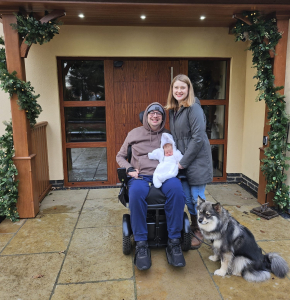
Drawing on the practical experience gained during five years in the adapted rental property, Ed and Izzy worked closely with Steven Docker Associates to design a bespoke, purpose-built home tailored to Ed’s needs, with level access throughout and the flexibility to adapt over time. Their involvement at every stage ensured that the finished home reflected not only accessibility requirements, but the way the family wanted to live, both now and in the future. Take a look at a case study from Steven Docker Associates showing how their work with Ed and Izzy created a fully accessible home for their family.
Why Long-Term Planning Matters in Catastrophic Injury Cases
It was only later, after retraining in law, that Ed began to fully understand how decisions made early after injury can shape life many years down the line.
With the benefit of legal training, he was able to look back at his own experience and see rehabilitation funding, care provision and housing not as isolated issues, but as part of a long-term framework designed to support independence and quality of life over decades.
From this perspective, rehabilitation is not simply about maximising recovery in the months after injury. It is about planning for ongoing care needs, creating living environments that enable autonomy, and ensuring that support can adapt as life changes.
These considerations often sit outside acute medical treatment, yet they have a profound impact on how sustainable and fulfilling life after injury can be.
Ed’s experience has highlighted how closely medicine and law intersect in cases of catastrophic injury. Medical treatment addresses immediate survival and stability, but long-term planning – informed by legal support – helps translate that survival into a life with choice, dignity and continuity.
Why Ed Chose Barratts – and Why He Is Now Part of the Team
As Ed approached discharge from the spinal injuries unit, it became increasingly clear to him that his rehabilitation needs were not being fully addressed within the existing legal framework. Although he had already instructed solicitors, he felt that progress was limited at a critical point when decisions about rehabilitation, accommodation and care were becoming urgent.
Drawing on his medical training and his growing understanding of what lay ahead, Ed decided to take a more active role. He interviewed a number of leading personal injury law firms before selecting Barratts Solicitors to pursue his claim. What mattered to him was not only our legal expertise, but our clear understanding of catastrophic injury, rehabilitation pathways and the need for timely, coordinated action.
From Barratts’ perspective, Ed’s case stood out because of the urgency and complexity of his situation. With an imminent discharge from the spinal unit and no suitable accommodation in place, early intervention was critical. Barratts worked collaboratively with insurers under the Serious Injury Guide (and pushed to go beyond it) to secure case management, specialist rehabilitation at STEPS, appropriate accommodation and a structured care regime that could support Ed in the long term.
Reflecting on Ed’s later decision to join the firm as a trainee solicitor, Lesley Edwards, Partner and Head of Personal Injury at Barratts Solicitors has described his contribution as exceptional. Ed brings together three perspectives that are rarely held by one person: clinical understanding as a doctor, lived experience of catastrophic injury and rehabilitation, and formal legal training in serious injury law. That combination informs not only how he understands cases, but how he listens to clients, anticipates challenges and appreciates the realities behind the paperwork.
“I came to work at Barratt’s to pay forward the life changing service they provided me, to use my experience to help the next individual in a position similar to mine maximize their potential and live the life they deserve.” Ed Hudson, January 2026
Life After Injury Is About Adaptation, Not “Overcoming”
Public attention has understandably focused on visible milestones such as Ed’s wedding and the moment he walked down the aisle. While those events carry personal meaning, Ed is clear that they do not represent “overcoming” his injury.
Rather, they are part of living well within a life that has been reshaped by permanent change.
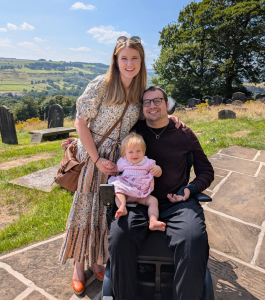
Assistive technology plays a practical role in enabling those moments, but Ed does not see it as symbolic. Tools such as powered mobility or wearable devices are simply that – tools.
They facilitate participation. They are not signs of recovery or transformation. Their value lies in what they make possible day to day, not in how they appear from the outside.
Framing life after injury solely around headline moments can place unhelpful pressure on others who are earlier in their journey. Ed’s experience points to a different reality.
Progress is built through adaptation, sustained support and careful planning over time. Fulfilment does not depend on exceptional moments, but on creating a life that works consistently and realistically in the long term.
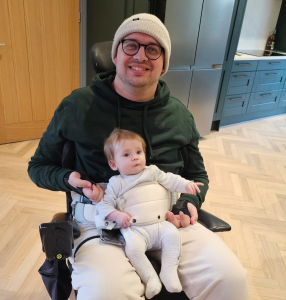
If You Are Newly Injured: What the Early Months Can Feel Like
For many people, the early stages after a serious injury are overwhelming.
Pain, exhaustion and uncertainty can sit alongside a constant stream of information and decisions, often at a time when physical and emotional reserves are already depleted. Ed recognises that this period can feel not just difficult, but deeply destabilising.
In the months after injury, it is common for life to feel dramatically smaller. Days may revolve around a single room, a rigid routine or the next clinical task, with little sense of how that narrow world might ever expand again.
This is not a failure of resilience or attitude. It is a natural response to sudden and profound change.
Ed’s experience offers realism shaped by time. With appropriate support, specialist rehabilitation and the space to adjust, perspective can shift gradually.
Progress is rarely quick or linear. The way life feels in the earliest stages is not necessarily how it will always feel. Change, when it comes, often arrives quietly – through adaptation, understanding and the steady rebuilding of confidence over time.
What Lived Experience Brings to Understanding Serious Injury Law
Ed now works in personal injury law as a trainee solicitor at Barratts. He brings together his background in medicine, his lived experience of spinal cord injury, and his developing legal expertise.
This combination gives him a perspective shaped not by theory alone, but by navigating rehabilitation, care and long-term planning firsthand.
Living with a catastrophic injury has informed how Ed understands uncertainty, adjustment and the pace at which change can realistically occur. It has fostered patience, attentiveness and an appreciation of how complex and individual each journey can be.
Ed’s journey reflects what can emerge when appropriate support, informed decision-making and time are allowed to work together. For those at the start of their own journey, his perspective offers understanding, stability and a sense of direction.
If you would like to talk to someone
If this article has raised questions about rehabilitation, long-term planning or life after serious injury, you may find it helpful to speak to someone with experience in this area.
Lesley Edwards is a Partner and Head of Personal Injury at Barratts Solicitors. She acted for Ed during his serious injury claim and works with people who have sustained catastrophic injuries, where early, informed support around rehabilitation, care and long-term needs is critical.
You can view Lesley’s profile
You can also find details of the wider personal injury team